Hyperspectral Camera for Drone: Unlocking New Possibilities in Agriculture, Mining, and More

Hyperspectral cameras are changing the world of drone technology for the better by adding detail and precision that many industries could only dream of before. Regardless of if you are in agriculture, mining, forestry, or environmental analysis, analyzing and collecting data will be easier with this revolutionary tool. There are countless benefits of using these cameras with drones that will be discussed in this post. These cameras are also creating advantages that make them a must-have for many industries.
What Is a Hyperspectral Camera for Drone?
Hyperspectral cameras are special cameras that can sense light that are separated into hundreds or thousands of individual range bands. Unlike regular cameras that can only see 3 bands (red, green, and blue), hyperspectral cameras can capture images over a wider spectrum of wavelengths that include some that are invisible (like near-infrared, shortwave infrared, and thermal bands).
When mounted on a drone, hyperspectral cameras can be used to collect images of a very large area in a short period of time which allows for large scale analysis of the material/chemical composition to support the evaluation and monitoring of various environmental issues. When a detailed analysis of material, vegetation, or contaminant pollution is necessary, a hyperspectral camera for drone is essential.
How Hyperspectral Cameras for Drones Are Used?
Using hyperspectral cameras that are mounted on drones creates many opportunities across industries. A few examples of how they are being used currently are:
1. Agriculture and Crop Management
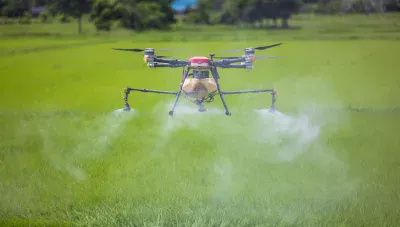
Hyperspectral imaging is a big deal in agriculture. With this technology, drones can see how healthy a crop is, how healthy it can become, and even the early signs of the plant’s diseases and monitor them. Water plant diseases can even be spotted. Since the plant world is a mystery to the naked eye, hyperspectral imaging gives a view to the innards of the plant and provides guidance about how to better control irrigation, fertilization, and pest management.
2. Environmental Monitoring
Drones equipped with hyperspectral cameras are essential for tracking and identifying ecosystem changes in environmental research. They are employed in soil composition analysis, pollution detection, water quality evaluation, and deforestation monitoring. The accuracy of hyperspectral imaging enables scientists to collect vital information for conservation efforts, whether it’s monitoring the spread of pollutants in water bodies or identifying early indicators of environmental stress.
3. Mining and Geology
Drone hyperspectral imaging is especially useful in the geology and mining industries. Large tracts of land can be swiftly scanned by drones with hyperspectral cameras, which can map rock formations, identify mineral deposits, and analyze soil types. Planning mining operations and making sure that resources are extracted as sustainably and efficiently as possible require this level of detail.
4. Disaster Response and Recovery
Drones equipped with hyperspectral cameras are also employed in disaster relief. Drones provide real-time data that can help with disaster response, whether it’s evaluating damage from floods, wildfires, or oil spills. Responders can make better decisions, speed up recovery times, and reduce environmental impact by swiftly surveying large areas and gathering spectral data.
Why Choose a Hyperspectral Camera for Drones?
Compared to more conventional imaging techniques like photogrammetry and multispectral cameras, using a hyperspectral camera for drone missions offers a number of clear advantages:
High-Resolution Data
By recording dozens or hundreds of spectral bands, hyperspectral cameras offer far more detailed information. This makes it possible to analyze materials, pollutants, and plant health in greater detail.
Non-Destructive Data Collection
Hyperspectral imaging makes it possible to collect data without physically sampling anything, which is particularly useful when researching delicate ecosystems or bodies of water.
Large-Scale Coverage
Drones are perfect for applications like environmental monitoring and agriculture because they can swiftly cover large areas. Large swaths of land can be scanned in a single flight using hyperspectral cameras.
Precision and Repeatability
Drones with top-notch hyperspectral cameras can repeat missions under the same circumstances, guaranteeing consistent data for long-term monitoring and analysis. Hyperspectral imaging necessitates precision.
Key Considerations for Hyperspectral Imaging with Drones
Although there are many advantages to using hyperspectral cameras on drones, there are a few things to think about before starting a hyperspectral mission:
1. Flight Planning and Stability
Hyperspectral cameras use a scanning technique called “push-broom“, meaning they are collecting data line by line, so the flight path must be continuous and stable while doing so. The momentary difference in speed or altitude can lead to data gaps or misalignment. Thus, accurate flight planning and stable control of the drone are important for successful data acquisition. Programmatic software like UgCS can help by optimizing flight paths, which keep the camera on (and track).
2. Sensor Calibration
Hyperspectral cameras must also be calibrated before and during the flight to collect data accurately. Calibration is the step where you use known spectral targets to either correct for biases or inaccuracies in how your camera responds to light. This is especially true for difficult operating environments where parameters such as sunlight, atmospheric effects, or ground reflectivity have specific implications on quality of the data captured.
3. Data Processing and Storage
Hyperspectral data is relatively huge (it needs more storage space and specific processing software). The data must be interpreted with care and adjusted for distortions introduced by environmental effects or flight errors. Post-processing is as important as having the right software tools to make sense of what has been collected.
Popular Hyperspectral Cameras for Drones
There exists a variety of hyperspectral options for drones. Some of the leading models in use within the industry include:
- MicaSense Altum-PT: From MicaSense, a multispectral and thermal camera that fills the gap between traditional imaging and hyperspectral data collection. It is frequently used for agriculture and research.
- Headwall Nano-Hyperspec®: The Nano-Hyperspec is a small high-resolution sensor suitable for agricultural, forestry, and environmental monitoring applications.
- Resonon Pika Series: Widely employed for scientific and industrial applications, particularly known for analyzing vegetation; also used in mineral exploration.
- Specim AFX Series: Best for drones, onboard processing capabilities.
Conclusion: Maximizing the Potential of Hyperspectral Cameras for Drones
These sophisticated sensors unlock new possibilities, transforming fields like agriculture and environmental monitoring. Hyperspectral drone imagery allows to acquire over large areas and fast spans of spectral data in a non-destructive way, thus providing insight into a wide range of materials or phenomena.
The technology does have a higher price point and some operational complications, but the advantages are clear. If planned, calibrated, and processed correctly, drone-based hyperspectral imaging can provide accurate and actionable data that drives decision-making across many industries.
A hyperspectral camera for drone is truly a new level of data collection whatever you do: agriculture, mining, environmental research. Investing in reliable technology along with flight planning software such as UgCS will be the key to ensuring that your drone missions bring optimum results, maximizing the opportunities of hyperspectral camera for drone use cases.
So are you ready to step up your data collection with hyperspectral imaging? Discover the endless capabilities and utilize this state-of-the-art technology today!