Tethered Drone Technology: How It Works and Why It Matters?

In the last ten years, the drone industry has changed a lot. What started as technology for hobbyists has grown into mission-critical infrastructure used by militaries, broadcasters, emergency responders, and businesses all over the world. But tethered drone technology is still one of the most powerful and least understood of all the new technologies that are changing the UAV world.
The biggest problem with regular UAVs is their battery life, and a tethered drone fixes that. Operators get something that no battery can give them—unlimited, uninterrupted flight time—by connecting the plane to a ground station with a special cable.
What Exactly Is a Tethered Drone?
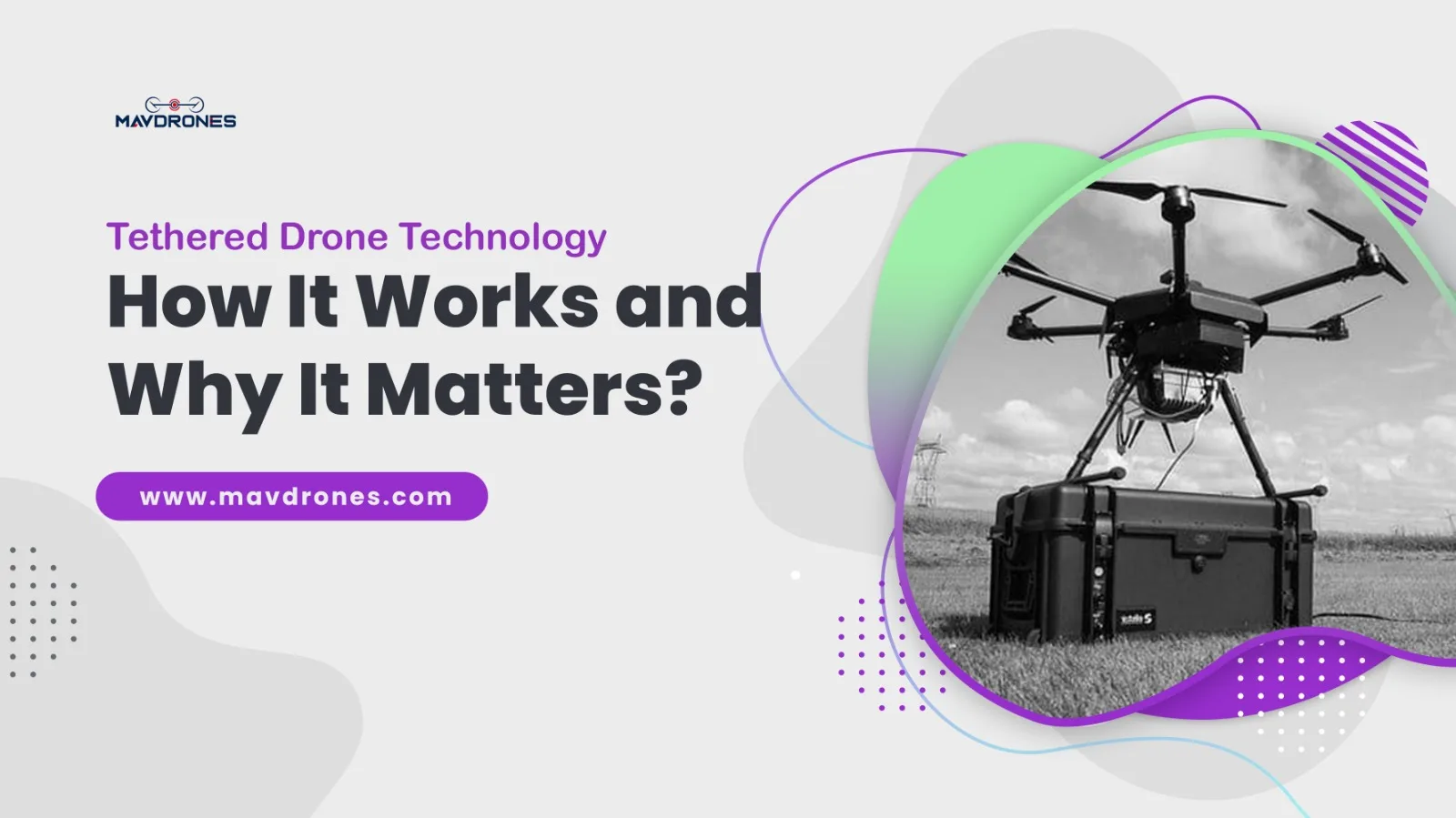
A tethered drone, also known as a captive UAV, is an unmanned aerial vehicle that is physically connected to a ground-based power and data station by a cable called a tether. Free-flying drones have to carry all of their energy with them, but tethered systems get power from the ground all the time while sending data through the same line.
The tether itself is an amazing piece of engineering. It needs to be strong enough to handle wind and mechanical stress, but light enough so that it doesn’t affect the drone’s lift. Copper wires for power and fiber-optic strands for data are woven together inside a weatherproof jacket in most commercial tethers. The whole thing weighs only a few grams per metre.
How the System Works: The Three Core Components?
Three parts that depend on each other must work together for every tethered drone system to work.
The Ground Station is the nerve center for operations. It connects to a main power source, like mains electricity, a portable generator, or a battery bank with a lot of power, and changes that power into the voltage the drone needs. It also handles all data routing, which lets operators see video feeds, telemetry, and sensor outputs in real time. Most ground stations are made to be deployed quickly in the field and come in small, tough cases.
The Tether Cable is the system’s physical and functional backbone. Power goes through it at a high voltage and low current to keep energy loss from resistance to a minimum over long distances. At the same time, fiber-optic strands send encrypted data between the drone and the person controlling it. Most standard commercial systems can handle altitudes between 50 and 150 meters, which is high enough for most surveillance, communication, and monitoring missions.
The Drone Platform is made or changed to accept power from the ground. Power conditioning units on board control the electricity that comes in and send it to motors and electronics in a clean way. These platforms can often carry heavier, more powerful payloads than their free-flying counterparts because they don’t have to carry batteries.
Why Tethered Drones Outperform Conventional UAVs?
The main problem with any battery-powered drone is that it doesn’t last long. Even the most advanced commercial UAVs can only fly for 30 to 60 minutes on a single charge, which is a big problem for operations that need a constant aerial presence. Tethered drones completely get rid of this problem.
A tethered UAV can hover in place for 24, 48, or even 72 hours, as long as it gets regular maintenance and the weather is good. That level of persistence is not a luxury for security operations, disaster response, and live broadcasting; it is a basic operational need.
The tether offers a key security benefit in addition to durability. The wireless communication links that regular drones use can be jammed, spoofed, and intercepted. A fiber-optic tether makes a data pipeline that can’t be intercepted from a distance, which is why tethered systems are the best choice for defence, law enforcement, and high-security business settings.
Real-World Applications That Are Changing Industries
The technology for tethered drones is no longer just a test. It is now being used in a lot of different fields.
Law enforcement and public safety agencies use tethered UAVs to keep an eye on things from above during big public events, emergencies, and search-and-rescue operations. Commanders get a constant view of the battlefield that no battery-powered drone can match because they can stay in the same place in the air for hours at a time.
One of the fastest-growing parts is military and defence. Tethered UAVs can be used as forward observation posts, communication relay nodes, and signals intelligence platforms. In areas where there is a lot of competition, where regular drones would be compromised almost right away, these drones are very useful because their data links are hardened and they can resist GPS jamming.
During hurricanes, floods, and infrastructure failures, tethered drones have already shown how useful they can be in disaster response and telecommunications. A drone with a cellular relay payload can be in the air in a matter of minutes, bringing back temporary broadband or voice service to people who need it while permanent repairs are being made.
Some other important uses are:
- Live broadcasting—permanent aerial camera platforms at concerts and sporting events that don’t make noise or have to deal with the rules that come with helicopters
- Protection of critical infrastructure means keeping an eye on the perimeter of oil refineries, ports, power plants, and data centers 24 hours a day.
- Border monitoring—continuous aerial coverage along long perimeters without needing to change crews often
Navigating the Regulatory Landscape
One good thing about tethered drones is that they are treated better by aviation rules in many countries. Because the physical tether greatly lowers the chance of uncontrolled flight, the US, the EU, and other places usually have less strict rules for licensing and airspace use for tethered UAVs than for free-flying aircraft.
That being said, operators still have to follow some rules. There are still rules about airspace near airports and helipads. Most rules say how long tethers can be to keep people safe in aircraft. And many places still have rules about having a clear line of sight. Before any deployment, it is absolutely necessary to check the current rules with the appropriate national aviation authority.
What the Future Holds?
The market for tethered drones around the world is growing quickly. Improvements in lightweight tether materials, more efficient power electronics, and AI-driven autonomous station-keeping are constantly making these systems more capable. Frameworks for managing urban air traffic that are being created all over the world are starting to include tethered platforms as a recognized type of aerial infrastructure.
The long-term goal is exciting: tethered drones that work as permanent aerial fixtures above important places. They are always on, always sending data, and only need human help for scheduled maintenance.
Final Thoughts
Tethered drone technology is not just a way to get around battery problems. It shows a completely different way of thinking about flying, one that puts endurance, data security, and mission reliability ahead of free movement. Tethered UAVs have already proven to be the best option for any application where persistence is more important than freedom of movement. As the technology gets better and more people start using it, their role in shaping the future of aerial operations will only get bigger.

CEO, Mavdrones
Pradipta V Mukherjee is the visionary CEO of Mavdrones & Drone Pathshala, driving innovation and growth in the drone industry. With a passion for advanced technology, he leads the company's strategic direction, ensuring Mavdrones stays at the forefront of drone solutions. Under his leadership, Mavdrones has achieved remarkable success, including winning the 'Best Innovation and Technology in Drone Industry' award from ASSOCHAM. Pradipta is committed to revolutionizing the industry through advanced UAV technology, fostering a culture of excellence and forward-thinking within the organization.