Different Types of Drones Used in Precision Agriculture: A Complete Guide

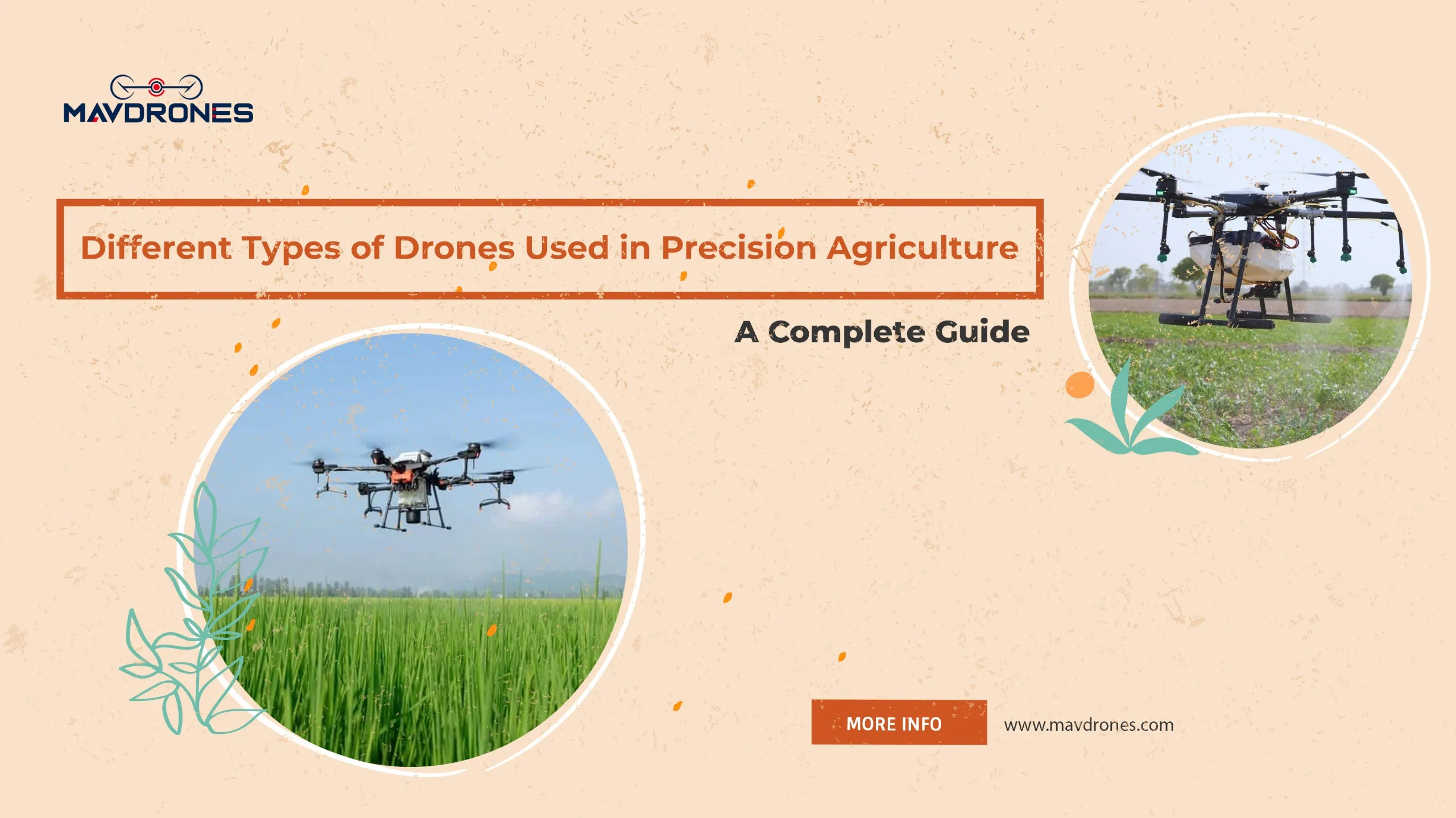
Precision agriculture is a revolutionary new way to farm that lets farmers make decisions based on data that boost productivity, lower costs, and have less of an effect on the environment. Drones, or unmanned aerial vehicles (UAVs), are one of the most important technologies that make this change possible.
Drones are no longer just cameras in the air; they are smart systems with advanced sensors, AI, and automation. Drones are now a key part of smart farming ecosystems. They can do everything from checking on the health of crops to spraying fertilizers with perfect accuracy. Different types of drones are needed for different farming tasks, and each type is made for a specific use in agriculture.
Overview of Drone Types in Precision Agriculture
A look at the different types of drones used in precision agriculture:
| Drone Type | Key Strength | Ideal For | Coverage Capacity |
|---|---|---|---|
| Fixed-Wing | Long endurance | Large farms & mapping | Very High |
| Multi-Rotor | Precision & control | Monitoring & spraying | Medium |
| Hybrid VTOL | Flexibility + endurance | Mixed terrain farms | High |
| Spraying Drones | Payload & automation | Crop protection | Medium |
| Mapping Drones | Data collection | Surveying & analytics | High |
| Monitoring Drones | Real-time imaging | Crop scouting | Medium |
| Thermal/Multispectral | Advanced crop insights | Health & stress detection | High |
| AI-Powered Drones | Automation & intelligence | Smart farming | Very High |
1. Fixed-Wing Drones
Fixed-wing drones are built like planes and are commonly used in precision agriculture for big jobs. They don’t use rotary motion to lift themselves; instead, they rely on forward motion, which makes them very energy-efficient.
These drones are especially useful for farms that cover hundreds or even thousands of acres. They can cover a lot of ground in one mission because they can fly for a long time. This cuts down on the time it takes to do their jobs by a lot.
Key Benefits:
- Longer flight times (up to a few hours)
- Quickly covering large areas of farmland
- Great for surveying and mapping
Use Cases:
- Using multispectral sensors to map the health of crops
- Analysis of soil variability
- Planning for irrigation and keeping an eye on things on a large scale
Limitations:
- Needs room to take off and land
- Not as good for tasks that require precision, like spraying
2. Multi-Rotor Drones
Multi-rotor drones are the most popular type of UAV in farming because they are easy to use and can do a lot of different things. These drones can hover, move exactly, and fly at low altitudes, which makes them great for detailed inspections.
They are very helpful for farms that are small to medium-sized and need accuracy more than coverage.
Key Benefits:
- Very stable and easy to control
- Ability to hover for detailed imaging
- Simple to set up and use
Use Cases:
- Monitoring crops up close
- Finding pests and diseases
- Field imaging with high resolution
Limitations:
- Less time in the air than with fixed-wing drones
- Limited coverage for each flight
3. Hybrid VTOL Drones (Vertical Take-Off and Landing)
Hybrid VTOL drones have the best features of both fixed-wing and multi-rotor drones. They can take off straight up and then fly forward, which is both flexible and efficient.
This makes them perfect for farms that don’t have a lot of space but need to cover a lot of ground.
Key Benefits:
- No need for a runway
- Longer flight time
- Good for mapping on a large scale
Use Cases:
- Surveying farms
- Scouting crops on uneven ground
- Collecting data for precision farming
Why They Matter?
More and more people are using hybrid VTOL drones because they solve one of the biggest problems in farming: how to balance coverage with operational flexibility.
4. Agricultural Spraying Drones
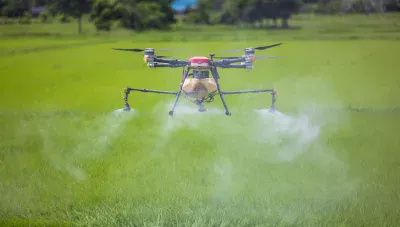
Agriculture Drones are made just for protecting crops and applying nutrients. These drones have tanks, pumps, and nozzles that let them spray pesticides, herbicides, and fertilizers very accurately.
They are changing the way people spray by making it safer and more effective.
Key Features:
- Spraying with GPS guidance
- Flow rates that can be changed
- Flight paths that are automatic
Benefits:
- Lessens the use of chemicals
- Reduces the amount of harmful substances that people come into contact with
- Makes sure that coverage is the same everywhere
Ideal For:
- Applying pesticides with precision
- Spraying fertilizer
- Hard-to-reach places like hilly fields or fields that are too wet
5. Mapping and Surveying Drones
For collecting and analyzing field data, mapping drones are very important. These drones have high-resolution cameras and advanced sensors that make maps and models that are very accurate.
The information that is collected is turned into useful insights that help farmers make their businesses run better.
Key Outputs:
- Orthomosaic maps
- 3D terrain models
- NDVI and vegetation index maps
Benefits:
- Improved farm planning
- Better resource allocation
- Increased crop productivity
6. Monitoring and Scouting Drones
People use monitoring drones to check on crops on a regular basis during the growing season. They give farmers real-time data that helps them find problems early on.
Early detection is very important in farming because it lets farmers fix problems before they get worse.
Key Applications:
- Disease detection
- Pest infestation monitoring
- Crop growth tracking
Advantages:
- Saves time compared to scouting by hand
- Gives data that is correct and consistent
- Helps people make better choices
7. Thermal and Multispectral Drones
These drones have special sensors that can pick up data that is not visible to the naked eye. They give us more information about the health of crops than regular cameras can.
Multispectral Imaging Helps:
- Find plant stress early
- Find out what nutrients are missing
- Watch for changes in the health of crops
Thermal Imaging Helps:
- Analyze irrigation efficiency
- Detect water stress
- Identify drainage problems
These drones are especially useful for precision farming because they let you manage things ahead of time instead of after the fact.
8. Autonomous and AI-Powered Drones
The most recent improvement in agricultural drone technology is the use of AI and automation together. Drones with AI can look at data in real time and do things with little help from people.
Key Capabilities:
- Automated flight planning
- AI-based crop analysis
- Real-time decision support
Benefits:
- Increased efficiency
- Reduced labor dependency
- Faster and smarter farming decisions
These drones are a sign of the future of farming, when farms will be smart and run by data.
Key Factors to Consider When Choosing a Drone
There are many things to think about when choosing the right drone. Farmers and agri-businesses should think about:
- Farm Size: You need fixed-wing or VTOL drones for big farms.
- Purpose: To spray, map, or keep an eye on
- Budget: More advanced drones cost more
- Terrain: VTOL drones may be needed on uneven ground
- Data Needs: Basic imaging vs. advanced analytics
Conclusion
Drones are now a must-have for modern farming, not just an option. There are many different kinds of drones, each with its own job, like mapping large areas, spraying crops with precision, and doing advanced data analysis.
Fixed-wing drones cover the most ground, multi-rotor drones are the most accurate, and hybrid VTOL drones are the most flexible. At the same time, farmers are moving toward smarter and more sustainable practices thanks to advanced drones that use thermal, multispectral, and AI technologies.
As drone technology gets better, it will play an even bigger role in farming, helping farmers get more crops, spend less money, and manage their resources better. Buying the right kind of drone is more than just an upgrade in technology; it’s a smart move for the future of farming.

CEO, Mavdrones
Pradipta V Mukherjee is the visionary CEO of Mavdrones & Drone Pathshala, driving innovation and growth in the drone industry. With a passion for advanced technology, he leads the company's strategic direction, ensuring Mavdrones stays at the forefront of drone solutions. Under his leadership, Mavdrones has achieved remarkable success, including winning the 'Best Innovation and Technology in Drone Industry' award from ASSOCHAM. Pradipta is committed to revolutionizing the industry through advanced UAV technology, fostering a culture of excellence and forward-thinking within the organization.