Drone vs UAV Explained: Are They Actually the Same Thing?

The words “drone” and “UAV” are everywhere today—military briefings and YouTube reviews, Amazon delivery announcements and agricultural technology conferences. But many people wonder whether these words mean the same thing or describe completely different technologies. As unmanned aircraft become more prevalent in everyday life, the confusion around the terminology of UAV vs drone has only increased.
So in a nutshell , they are closely related , but context matters . The term UAV is often preferred by aviation professionals, regulators and defence organisations while consumers and hobbyists usually say drone. Here’s the full UAV vs drone distinction, unmanned aircraft technology, real-world applications, and where the industry is going in 2026 and beyond, broken down in this guide.
What Is a UAV?
What is a UAV ? Unmanned Aerial Vehicle . An aircraft without a pilot on board . The vehicle can be controlled remotely by a pilot on the ground, or can fly autonomously using onboard software, sensors and GPS systems.
Mostly it was a product of military and aerospace circles. Defence agencies required a technical and standardised term to describe unmanned aircraft used for surveillance, reconnaissance and combat missions. Eventually the terminology extended into commercial aviation, industrial inspection, agriculture and scientific research.
When we talk about what is a UAV, it is also important to understand the term UAS (Unmanned Aircraft System). A UAV is just the aircraft, but a UAS is the aircraft, the ground control station, the communications systems, the operators and supporting software.
In the workplace, the terms drone versus unmanned aerial vehicle is often a matter of language preference. Aviation authorities, regulators and enterprise users often choose “UAV” because it sounds more technical and precise.
What Is a Drone?
A drone is a more popular, consumer-friendly term for an unmanned vehicle. Today, most people think of drones as flying quadcopters used for photography, racing, mapping or fun.
The word “drone” is said to have originated from the buzzing sound of early unmanned aircraft, similar to the sound made by male bees, also called drones. The term was first used in military applications but became mainstream in the 2010s with the advent of low-cost consumer drones.
The word drone technically applies to unmanned vehicles on land, sea or underwater. But in modern times it nearly always refers to flying unmanned aircraft.
When people are looking for types of drones or UAV vs drone, they are usually referring to the same broad category of aircraft. The difference is largely contextual, audience and industry specific language rather than the technology itself.
UAV vs Drone: Are They the Same Thing?
Yes and no is the answer to UAV or drone.
Technically, drone and UAV are the same unmanned flying aircraft. But the language is different, depending on who is speaking and for what reason. Defence agencies, regulators and aerospace engineers prefer “UAV” while consumers, media and hobbyists generally say “drone”.
A simple analogy helps to explain the difference. It’s like saying ‘automobile’ instead of ‘car’. They both mean the same thing . One is formal and technical , the other casual and familiar .
The rule is as follows:
- All consumer drones are UAVs.
- Not every UAV is casually called a drone.
For example, a military surveillance plane equipped with satellite communications and autonomous navigation systems can almost always be described as a UAV. Meanwhile, a DJI camera quadcopter used to make videos of your vacation will almost always be called a drone.
This subtle UAV vs drone difference is useful to know as you read regulations, industry reports, or product specifications.
Key Differences Between UAV and Drone — Comparison Table
| Feature | UAV | Drone |
|---|---|---|
| Terminology Origin | Military and aviation industry | Popular consumer language |
| Primary Users | Defence, industrial, government, enterprise | Consumers, hobbyists, creators |
| Level of Autonomy | Often advanced or autonomous | Usually manually controlled or semi-autonomous |
| System Complexity | Can include large-scale integrated systems | Typically simpler consumer systems |
| Typical Cost Range | ₹8 lakh to ₹80+ crore depending on mission type | ₹8,500 to ₹8 lakh for most consumer and prosumer drones |
| Regulatory Treatment | Often subject to stricter aviation rules | Consumer drone regulations apply |
| Common Examples | MQ-9 Reaper, RQ-4 Global Hawk | Skydio 2+, Parrot Anafi AI |
The key point to understand about the UAV vs drone debate is that the technology is very much the same but the language used is about the purpose and the audience. “UAV” is a technical and professional term, while “drone” is more accessible and recognized by the public.
Types of UAVs and Drones
Fixed-Wing UAVs
Fixed-wing UAVs are similar to conventional airplanes, using wings to generate lift. They are very efficient for long-range missions because they need less energy to fly. Military systems such as the RQ-4 Global Hawk can remain aloft for over 30 hours at a time, surveying large swaths of territory.
Multirotor Drones
Multirotor drones are currently the most popular consumer and commercial drones. Quadcopters, like the DJI Phantom and DJI Mavic, use multiple rotors to hover stably and move precisely. These drones are popular for aerial photography, surveying, and recreational flying, thanks to their ease of use and relative low cost.
VTOL Drones
VTOL means Vertical Take-Off and Landing. These drones combine the efficiency of fixed-wing aircraft with the hovering capability of multirotors. Logistics companies and defence organizations are increasingly using VTOL systems for long-range cargo delivery and reconnaissance missions.
Single-Rotor Helicopters
Single-rotor UAVs are comparable to traditional helicopters, featuring one large rotor and a smaller tail rotor. They can carry heavier payloads and fly for longer than many multirotor drones. This design is widely used for industrial inspection and cargo transportation applications.
Nano and Micro Drones
Nano and micro drones are miniature UAVs built for tight spaces and covert ops. One such famous example is the Black Hornet, a tiny military reconnaissance drone that fits in a soldier’s pocket. These systems are increasingly being deployed for indoor inspections and tactical surveillance.
Hybrid UAVs
Hybrid UAVs integrate characteristics of various aircraft classes. Some automatically switch from vertical take-off to efficient forward flight. Hybrid designs are common among companies developing advanced air mobility systems, as they offer better range, flexibility and operational efficiency.
Real-World Uses: Where UAVs and Drones Are Used Today
Military and Defence
Military organizations are still some of the largest UAV operators in the world. Systems such as the MQ-9 Reaper conduct surveillance, intelligence gathering and tactical strike missions. Drones in war have changed the nature of modern warfare, especially in Ukraine and the Middle East.
Agriculture and Precision Farming
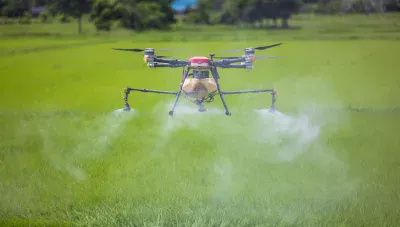
Drones help farmers monitor crop health, map fields and optimize irrigation. Multispectral sensors can detect plant stress before it’s visible to the human eye. The increasing demand for precision farming is resulting in the fast adoption of agricultural drones in India, China and the US.
Delivery and Logistics
Big companies are throwing money at autonomous drone delivery networks. Zipline and Amazon Prime Air have both performed commercial delivery operations in select markets. Blood, vaccines and emergency supplies are now delivered by medical drones to remote communities within minutes.
Aerial Photography and Filmmaking
Aerial shots became affordable and accessible with consumer drones, revolutionizing photography and filmmaking. Hollywood productions, real estate agencies and travel creators regularly use drones such as the DJI Inspire series to shoot cinematic footage. What used to take helicopters now can be done with small UAV systems.
Infrastructure Inspection
Infrastructure operators and energy companies use drones to inspect bridges, power lines, wind turbines, pipelines and telecom towers. UAV inspections decrease human risk and operational costs. Thermal cameras and LiDAR sensors aid in fast and accurate identification of structural problems.
Disaster Response and Search and Rescue
When floods, earthquakes or wildfires strike, emergency crews deploy drones to find victims and assess the damage. Thermal imaging drones can locate people trapped in hazardous environments that are hard for people to reach. UAV technology is increasingly used by search-and-rescue teams to respond more quickly.
Scientific Research and Environmental Monitoring
Researchers are using UAVs to monitor wildlife populations, glaciers, forests and ocean ecosystems. Environmental agencies use drones to monitor pollution, map deforestation and collect atmospheric data. NASA and other scientific groups also use UAV platforms for experimental research missions.
How Do UAVs and Drones Work?
Modern drones depend on multiple integrated technologies working in real time.
At the heart of the system is the flight controller. This is basically the drone’s onboard computer. It gathers information from sensors and tweaks the motors to keep it flying smoothly. The propulsion system, usually electric motors and propellers, creates lift and movement.
Most UAVs are also fitted out with GPS modules for navigation and position. Advanced systems can fly preprogrammed paths automatically using waypoint navigation software.
Sensors are a big part of drone capability. Cameras take images and video, thermal sensors detect heat signatures, and LIDAR systems generate 3D maps with high levels of resolution. Some industrial UAVs have also been equipped with AI-powered obstacle avoidance systems.
The drone is connected to the operator by radio signals, satellite systems or mobile networks which act as communication links. Rechargeable lithium batteries generally provide the power, but hydrogen fuel cells and hybrid engines are gaining ground.
As for operation, drones can be:
- Manually controlled
- Semi-autonomous with navigation assist
- Complete autonomy with AI and automated flight systems
That flexibility is what makes UAV technology relevant to so many industries.
UAV and Drone Regulations
Rules vary greatly from country to country, but most governments now require registration, pilot certification and operational restrictions.
FAA Part 107 rules govern commercial drone operations in the United States. Pilots must pass an aeronautical knowledge test and comply with limits on altitude, visibility, and controlled airspace.
India’s drones are controlled by the DGCA and Digital Sky platform. Operators must register any number of drones and comply with no-fly zones around airports, military bases and sensitive government areas.
In Europe, the EASA framework offers a common standard for drone regulations in EU member states. Risk categories determine the operational requirements based on drone size and mission complexity.
And regulations are evolving fast as commercial adoption picks up. Governments are weighing innovation against privacy and safety and air traffic control and national security.
The Future of UAV and Drone Technology
The future of UAV vs drone tech looks to be much more sophisticated than today’s consumer quadcopters.
AI is already driving autonomous flight systems that can navigate complex environments without needing to be constantly controlled by humans. AI-powered drones can recognize objects, avoid obstacles, and even collaborate on missions in real-time.
Another major area of development is drone swarms. UAVs can operate as a single coordinated unit for military operations, agriculture, mapping, and disaster response. The swarm technology significantly enhances coverage and efficiency.
Projects in Urban Air Mobility (UAM) are also gaining traction. Electric flying taxis for short urban transport routes are being developed by companies around the world. Governments hope that pilot programs will be expanded before the end of the decade.
5G connectivity will allow drones to communicate in real time, with lower latency and more reliable long-range operations. Short battery life is one of the biggest limitations of the industry, but hydrogen fuel cells may solve it.
Meanwhile, the anti-drone technology is becoming more and more important. Airports, military bases and public venues are investing in systems that can detect and safely disable rogue drones.
The next 10 years will likely reshape the way people think about transportation, logistics, security and aerial data collection.
FAQ
Q: Is a drone a UAV?
A: Yes, the majority of drones are UAVs, as they are unmanned aerial vehicles. But the term “UAV” is more common in professional and military contexts and “drone” is more common in consumer contexts.
Q: What does UAV stand for?
A: UAV is short for Unmanned Aerial Vehicle. It is an airplane which flies without a pilot on board.
Q: What is the difference between a drone and a UAV?
A: The primary UAV vs drone difference is one of terminology and context. UAV is the technical aviation term , drone is the more casual and widespread public term .
Q: Are UAVs only used by the military?
A: No. UAV applications are now used in agriculture, filmmaking, logistics, surveying, infrastructure inspection, scientific research and emergency response.
Q: Do I need a license to fly a drone?
A: In many countries commercial drone pilots must be certified or registered. Rules differ depending on drone size, location, and purpose.
Q: What is the most common type of drone?
A: Multirotor quadcopters are the most common type of drone because they are cheap, stable and easy to fly.
Conclusion
If you understand that the terms UAV and drone usually refer to the same technology, but from different points of view, it is much easier to see the difference between the two. “UAV” is the official aerospace and regulatory term while “drone” is the more common consumer-facing term.
As unmanned aircraft become increasingly important in defence, agriculture, logistics, filmmaking and research, knowing the right terminology helps when you are reading industry news, regulations or product specifications. The rapid development of autonomous systems, AI-assisted flight, and advanced air mobility will ensure that the UAV industry continues to evolve at an extraordinary pace over the next decade.
If you want to learn more about drone technology, regulations, and new UAV innovations, check out our related drone industry articles and guides.

CEO, Mavdrones
Pradipta V Mukherjee is the visionary CEO of Mavdrones & Drone Pathshala, driving innovation and growth in the drone industry. With a passion for advanced technology, he leads the company's strategic direction, ensuring Mavdrones stays at the forefront of drone solutions. Under his leadership, Mavdrones has achieved remarkable success, including winning the 'Best Innovation and Technology in Drone Industry' award from ASSOCHAM. Pradipta is committed to revolutionizing the industry through advanced UAV technology, fostering a culture of excellence and forward-thinking within the organization.