Drones for Law Enforcement: Transforming Modern Policing

Unmanned Aerial Vehicles (UAVs), or drones, have quickly become an important tool for police around the world. At first, drone technology was only used by the military. Now, police departments all over the country are using it to improve surveillance, make the public safer, and make their work easier. Drones are helping police respond faster, gather better information, and lower risks for both officers and civilians as crime patterns change and cities become more complicated.
This article looks at how police are using drones, their main benefits, how they are used in the real world, the problems they face with regulations, and what the future holds for UAV policing.
What Are Law Enforcement Drones?
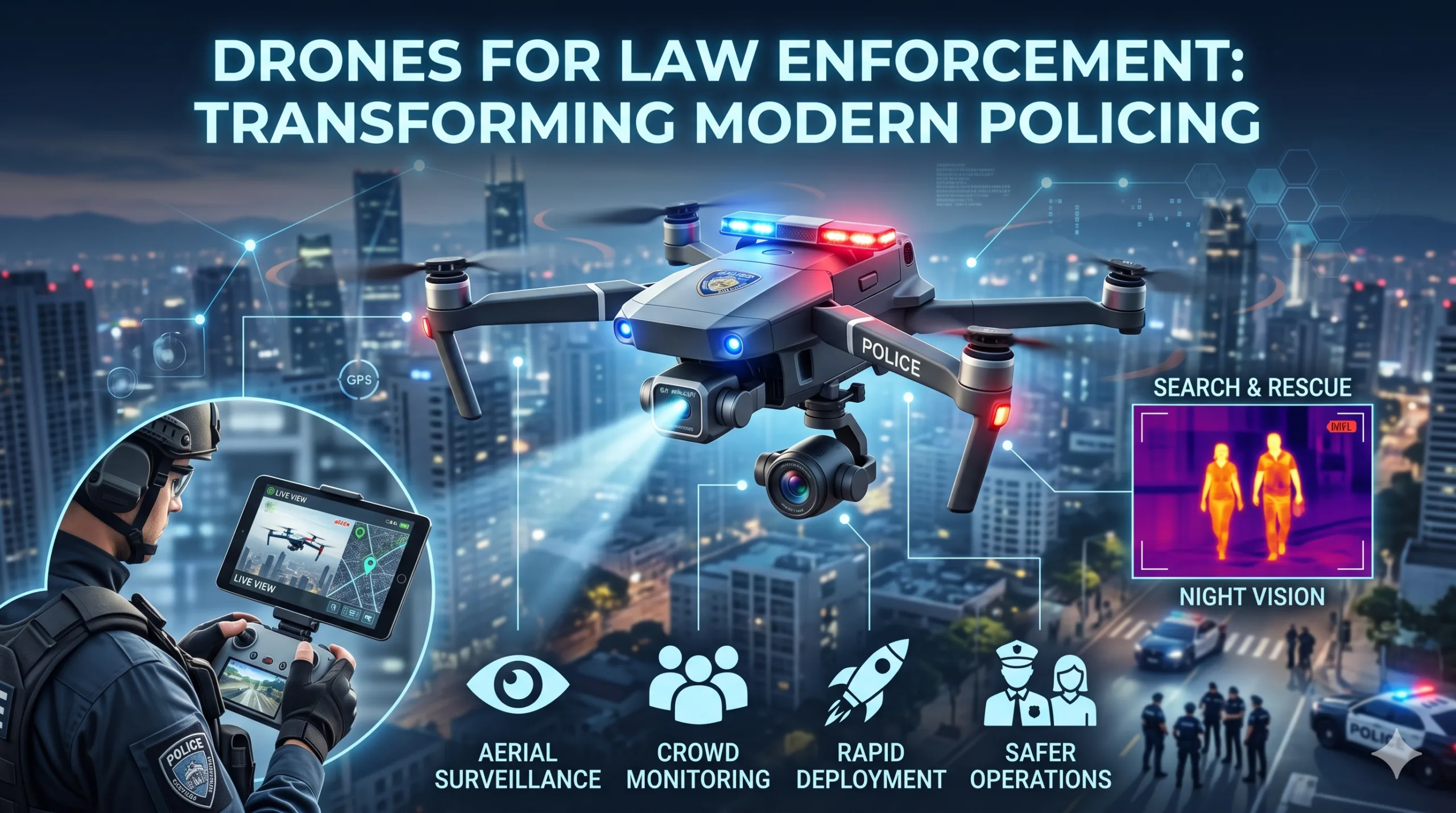
Law enforcement drones are special UAVs that have advanced technologies like high-resolution cameras, thermal imaging sensors, GPS tracking, and systems that send video in real time. These drones are meant to help police keep an eye on things from the air without the need for helicopters or big ground teams.
Drones can be used for a lot of different things, like watching people, looking for missing people, keeping an eye on traffic, responding to disasters, and even controlling crowds. Many modern police drones are small, easy to carry, and can be used in a matter of minutes.
Key Applications of Drones in Law Enforcement
1. Aerial Surveillance and Crime Monitoring
One of the most common ways police use drones is for aerial surveillance. Drones give police a bird’s-eye view of crime scenes, which lets them keep an eye on suspects, follow their movements, and get real-time information.
Drones can get to places that other types of surveillance can’t, like rooftops, narrow alleys, or dense forests. This ability makes them very good at keeping an eye on suspicious activities or following people who are trying to get away.
2. Search and Rescue Operations
Drones have made search and rescue missions a lot better. UAVs with thermal imaging cameras can see body heat, which makes it easier to find missing people, even in bad weather or at night.
Drones can quickly and efficiently cover large areas, which cuts down on search time and increases the chances of survival for people who are lost in the woods or trapped under debris after a disaster.
3. Crowd Monitoring and Event Security
Law enforcement has a hard time keeping large crowds under control at public events, protests, and festivals. Drones help authorities keep an eye on crowds, spot possible threats, and take action before they happen.
Real-time aerial footage helps ground teams work together better and make decisions faster in an emergency.
4. Traffic Management and Accident Investigation
More and more, drones are being used to watch traffic and look into accidents. They can quickly figure out how bad the traffic is, find the worst spots, and help keep the roads in good shape.
Drones can take detailed aerial pictures and videos of accidents. This helps put together what happened and makes investigations more accurate. This also cuts down on how long the roads need to be closed.
5. Disaster Response and Emergency Management
Drones are very important for finding survivors and assessing damage after natural disasters like floods, earthquakes, and fires. They can be used in dangerous places where it is hard or unsafe for people to get to.
Drones give authorities real-time situational awareness, which helps them use resources more efficiently and plan rescue operations.
6. Tactical Operations and SWAT Support
Drones are being used more and more in dangerous situations like hostage situations, drug raids, and armed standoffs. They give officers important information without putting them in danger.
Drones can gather information from a safe distance thanks to features like night vision and zoom. This helps tactical teams plan and carry out operations more quickly.
The Benefits of Using Drones in Law Enforcement
Enhanced Officer Safety
One of the best things about drones is that they keep police officers out of dangerous situations. Drones give law enforcement real-time visuals so they can evaluate risks before taking action.
Cost-Effective Operations
Drones are much cheaper to buy, use, and take care of than helicopters. This makes them available to even small police departments with tight budgets.
Rapid Deployment
Drones can be sent out in minutes, which makes them perfect for emergencies. In life-or-death situations, their ability to act quickly can make all the difference.
Improved Efficiency and Coverage
Drones can quickly cover large areas, which makes operations more efficient. They also cut down on the need for a lot of workers, which lets agencies use their resources more effectively.
Challenges and Concerns
Privacy and Ethical Issues
People are worried about privacy and civil rights because drones are being used for surveillance. If not properly controlled, constant monitoring and data collection could be misused.
To keep the public’s trust, law enforcement agencies need to make their rules clear and be open about what they do.
Regulatory Compliance
Aviation rules apply to drone operations, but they are different in each country. The Directorate General of Civil Aviation (DGCA) in India, for example, is in charge of how drones are used.
Police departments must make sure that licensing, airspace restrictions, and operational guidelines are followed.
Technical Limitations
Drones have some problems, like short battery life, sensitivity to weather, and interference with signals. These things can affect performance, especially on important missions.
Drones for Law Enforcement in India
More and more police departments in India are using drones. Police in cities like Delhi, Mumbai, Hyderabad, and Bengaluru are using drones to keep an eye on people, traffic, and crowds.
Drones have been used a lot at big events, elections, and public gatherings to keep people safe and keep things in order. Drones were also used during the COVID-19 pandemic to keep an eye on people who were following the rules and to send out public safety messages.
India is quickly becoming a center for UAV innovation in law enforcement thanks to programs like “Digital Sky” and more support for drone technology.
The Future of Drones in Policing
AI-Powered Surveillance
In the future, drones may have AI algorithms that can spot suspicious behavior, recognize faces, and find threats in real time.
Autonomous Drone Operations
More and more autonomous drones that can patrol certain areas without any help from people are likely to become available. In an emergency, these drones could be the “first responders”.
Integration with Smart Cities
Drones will be an important part of integrated surveillance systems as cities get smarter. They will work with CCTV cameras, sensors, and data analytics platforms.
Conclusion
Drones are changing the way police work by making it faster, safer, and more efficient to keep the public safe. UAV technology is changing the way police work today, from surveillance and search operations to disaster response and tactical missions.
But as more people start using it, it’s important to address privacy issues, make sure the rules are followed, and spend money on the right training. Drones can greatly improve the abilities of law enforcement and make communities safer when they are used responsibly.
For agencies and organizations looking into drone solutions, the choice is clear: UAV technology is no longer a choice; it is becoming a necessary part of policing in the future.

CEO, Mavdrones
Pradipta V Mukherjee is the visionary CEO of Mavdrones & Drone Pathshala, driving innovation and growth in the drone industry. With a passion for advanced technology, he leads the company's strategic direction, ensuring Mavdrones stays at the forefront of drone solutions. Under his leadership, Mavdrones has achieved remarkable success, including winning the 'Best Innovation and Technology in Drone Industry' award from ASSOCHAM. Pradipta is committed to revolutionizing the industry through advanced UAV technology, fostering a culture of excellence and forward-thinking within the organization.