Drone Surveillance Set to Transform Railway Security in Uttar Pradesh

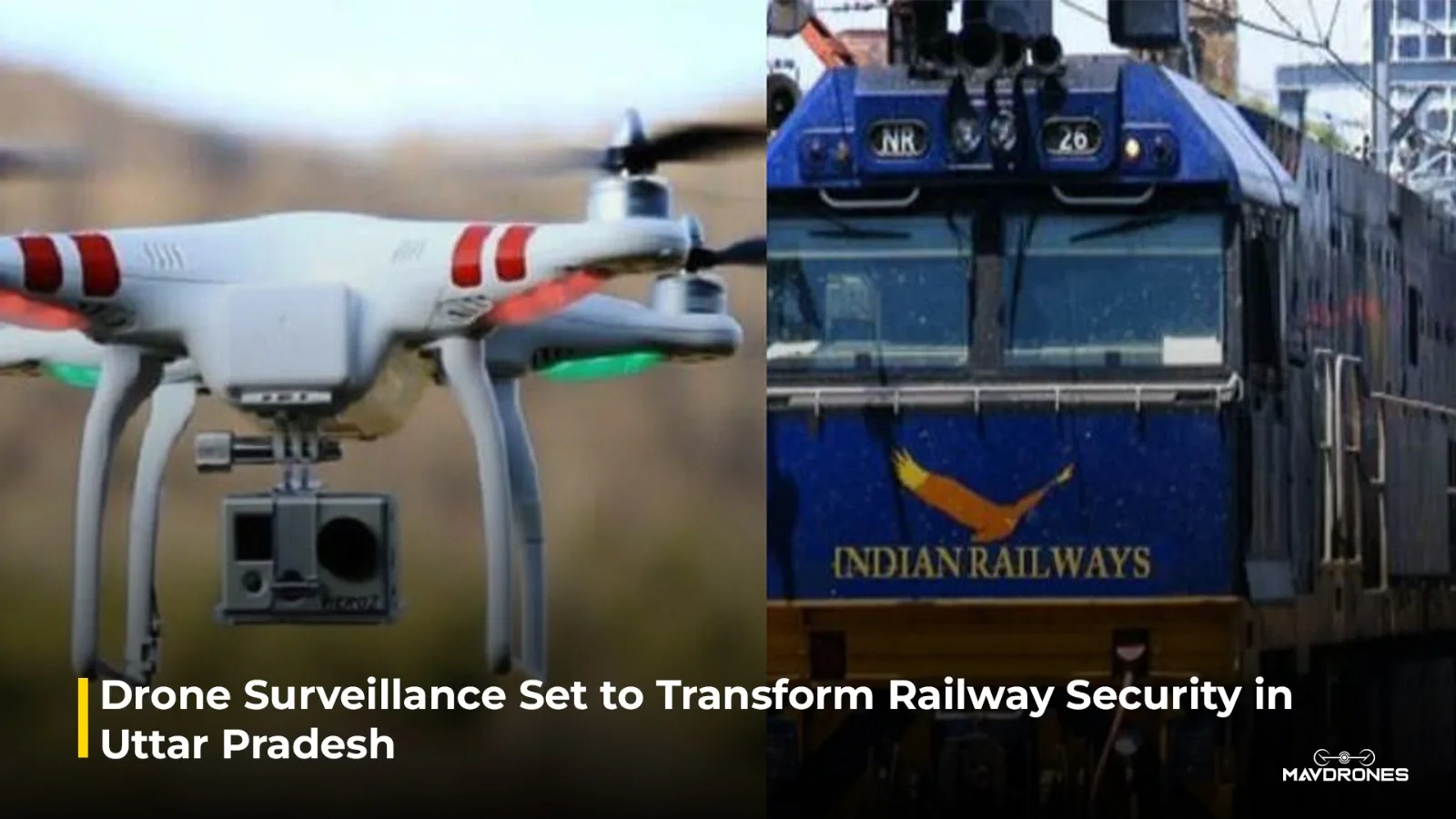
The Government Railway Police plans to add more unmanned aerial vehicles to Uttar Pradesh’s railway security network. This will help them keep an eye on more vulnerable parts of the state’s huge rail system.
It has been said that six surveillance drones will be bought, one for each of the main divisions. The procurement process is well underway, and the expansion is expected to greatly improve monitoring capabilities in important railway areas like Lucknow, Moradabad, Gorakhpur, Prayagraj, Agra, and Jhansi. Two drones had already been added earlier to get ready for the 2025 Mahakumbh. Now, their use is being expanded through a wider rollout.
The drones will be used to monitor railway tracks, yards, and other high-risk areas from the air in real time, especially in places where regular patrols can’t go because of rough terrain or bad visibility. Aerial surveillance should make it easier to find early signs of track tampering, strange movement, or attempts to damage signaling systems. This will let ground teams respond faster.
Recent security issues, such as attempts to sabotage and repeated stone-throwing at trains, have led to the decision to use more drones. As more people use the state’s rail network, the need for better security and quick response systems has grown even more.
Before the 2025 Mahakumbh in Prayagraj, a large-scale security drill took place. During this drill, coordinated patrols were carried out on more than 16,000 kilometers of railway track. The Government Railway Police, the Railway Protection Force, local police units, village watch personnel, and railway staff were all involved in the effort to keep things running smoothly during the busy event.
The exercise revealed gaps in surveillance coverage, especially in parts of the rail network that are far away from other parts. The results have led to a move toward monitoring solutions that are based on technology, with drone surveillance now seen as an important part of the security framework.
In addition to using aerial systems, enforcement actions against crimes like stone-throwing are getting tougher. Investigations are being carried out more thoroughly, with the goal of getting convictions to act as a deterrent. Recently, people who threw stones in Raebareli were found guilty and given a year in prison. This shows that the government is taking a tougher stance on these kinds of events.
Data-driven strategies are also being used. For example, incidents are being mapped out to find patterns that happen again and again, places that are more likely to be attacked, and people who commit crimes more than once. This information is likely to help with more focused interventions and the use of resources.
Officials have said that the Government Railway Police, Railway Protection Force, and district police units will work together more closely thanks to the use of drones for surveillance, especially during busy travel times and big public events.
We are currently finishing up standard operating procedures that cover things like getting permission to do things, how to handle data, and how to work together with other agencies. Once these frameworks are in place, the new drones are expected to be used in phases, with the divisions that have had more security-related incidents getting them first.
With the planned expansion, unmanned aerial surveillance is being set up as a key tool to help protect railway infrastructure and keep passengers safe on Uttar Pradesh’s large rail network.

CEO, Mavdrones
Pradipta V Mukherjee is the visionary CEO of Mavdrones & Drone Pathshala, driving innovation and growth in the drone industry. With a passion for advanced technology, he leads the company's strategic direction, ensuring Mavdrones stays at the forefront of drone solutions. Under his leadership, Mavdrones has achieved remarkable success, including winning the 'Best Innovation and Technology in Drone Industry' award from ASSOCHAM. Pradipta is committed to revolutionizing the industry through advanced UAV technology, fostering a culture of excellence and forward-thinking within the organization.