India’s Drone Revolution Has Begun — And the Military Just Confirmed It!

India’s drone industry seems to have crossed a decisive threshold, with the country’s top military leadership now viewing unmanned systems not as auxiliary tools, but as core instruments of modern warfare and national capability.
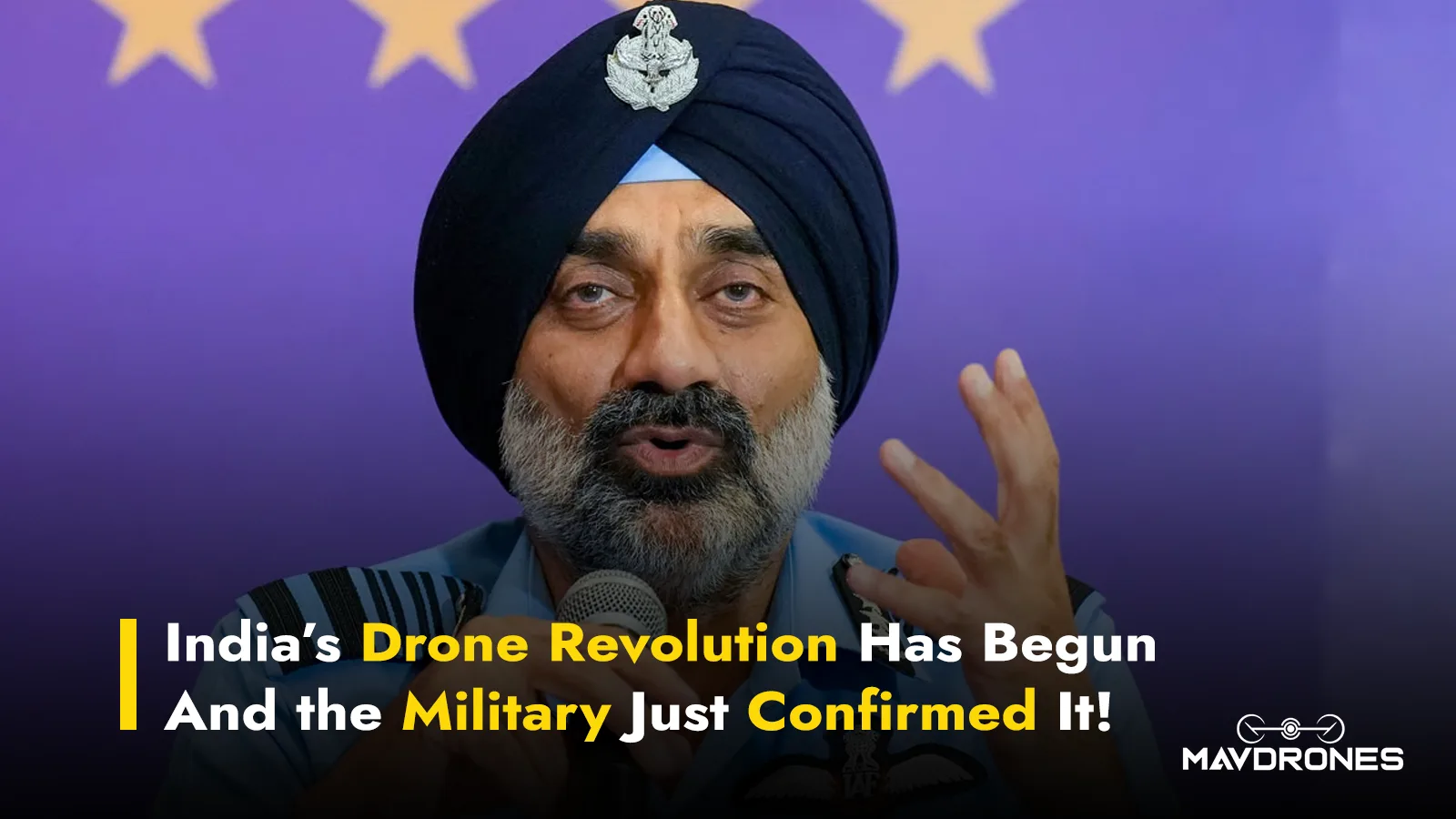
Indian Air Force Chief Air Chief Marshal A P Singh delivered what many analysts regard as a defining statement on the country’s evolving drone doctrine when he spoke at a defence seminar co-hosted by the Centre for Aerospace Power & Strategic Studies (CAPSS) and Indian Military Review at Subroto Park in New Delhi on May 15. “Drones and unmanned aerial systems are not just eyes in the sky anymore,” he said. Now they’re claws in the sky.
The comment, made in the context of lessons learnt from Operation Sindoor and the changing character of aerial combat, was reflective of a broader shift underway across India’s defence establishment. Unmanned systems are increasingly being seen as offensive, networked and autonomous platforms that can change the battlespace, not just as eyes in the sky.
Air Chief Marshal Singh said the recent conflicts and operational experiences have also brought to fore that the nature of warfare is rapidly transitioning from centralised command structures to decentralised and autonomous systems which can operate in contested environments with minimal human intervention. Under this new doctrine, drones are to serve as distributed assets embedded in larger combat networks rather than stand-alone machines performing small reconnaissance missions.
He also called the Integrated Air Command and Control System (IACCS) as key to India’s ability to coordinate responses to aerial threats, including hostile drones and unmanned swarms, which was a major focus of his remarks. It is a system designed to fuse inputs from multiple sensors and platforms into a single operational picture, and it has become more important as low-cost aerial threats have proliferated on modern battlefields.
Military strategists worldwide are wrestling with what Air Chief Marshal Singh called the “cost asymmetry” of drone warfare – where cheap, unmanned systems can force defenders to deploy much more expensive interception technologies. He said the problem is not theoretical any more. Cheap attack drones, loitering munitions and autonomous aerial systems are altering the economics of conflict, imposing disproportionate defensive costs on conventional militaries.
The Indian Air Force chief also warned against the idea of full autonomy as a short-term substitute for human decision-making in combat. Instead, he argued, the future is in manned-unmanned teaming, where piloted aircraft and autonomous systems work in concert. Such integration could help air forces extend operational reach, lower pilot risk, and perform simultaneous surveillance, electronic warfare and strike missions with more efficiency, defence experts say.
But Singh understood that drone warfare is still part of an endless technological battle. The development of unmanned systems is driving an equally rapid expansion of counter-drone technologies, resulting in what he called an ongoing “cat-and-mouse game” between offensive and defensive capabilities, he said. The race is increasingly influencing procurement priorities, research spending and operational planning across the major militaries.
Those comments are important not just for defence circles. Analysts say the rhetoric coming from India’s military leadership is now in line with a larger national push to make the country a big global drone ecosystem.
In the last five years, India’s drone industry has seen a dramatic regulatory and industrial transformation. The Drone Rules 2021 have provided for a much liberalised operating environment by reducing the requirements of approvals, simplifying licensing procedures and opening up opportunities for commercial deployment. The Production Linked Incentive (PLI) scheme for drones and drone components also indicated the government’s desire to develop local manufacturing capacity and cut reliance on imports.
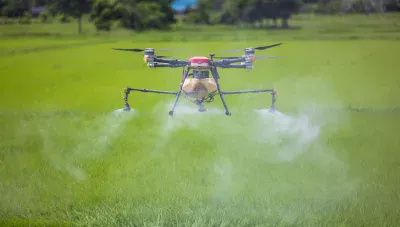
Thus, a number of civilian sectors have seen rapid growth. State governments and agritech companies are adopting aerial spraying, crop monitoring, and precision farming solutions at a rapid clip, expanding agricultural drone operations. Infrastructure and mining companies are employing drones for surveying and inspection, while logistics companies are still trialling unmanned delivery systems for difficult-to-reach terrain and remote areas. The use of unmanned platforms has also been accelerated in urban policing, disaster management and surveillance operations.
Industry estimates suggest India’s drone economy could become one of the fastest-growing technology segments in the country over the next decade, underpinned by rising defence demand, favourable regulation and expanding commercial use cases.
But the rapid growth is putting a spotlight on a key workforce challenge: a shortage of trained drone professionals.
As drones are increasingly incorporated into strategic and civilian operations, the demand for DGCA-certified remote pilots and unmanned systems specialists has skyrocketed. Training institutions, aviation experts and industry executives say the country still has a big gap in skills, particularly in such fields as autonomous flight operations, aerial mapping, drone maintenance, mission planning and counter-UAS systems.
The growing use of homegrown drone ecosystems in the defence space is also creating fresh opportunities for engineers, software developers, avionics specialists and AI experts developing navigation systems, integrating payloads and operating autonomously. With India simultaneously boosting its military drone capability and civilian adoption, trained personnel are increasingly viewed as strategic assets within the wider national technology ecosystem.
Air Chief Marshal Singh’s comments this week showed how deeply drones are now woven into India’s future security fabric. But they also reflected something bigger: a rising awareness that unmanned systems are no longer a niche technology segment. They are the foundation of India’s plans to defend its borders, modernise industry, and compete in the next age of technological power.

CEO, Mavdrones
Pradipta V Mukherjee is the visionary CEO of Mavdrones & Drone Pathshala, driving innovation and growth in the drone industry. With a passion for advanced technology, he leads the company's strategic direction, ensuring Mavdrones stays at the forefront of drone solutions. Under his leadership, Mavdrones has achieved remarkable success, including winning the 'Best Innovation and Technology in Drone Industry' award from ASSOCHAM. Pradipta is committed to revolutionizing the industry through advanced UAV technology, fostering a culture of excellence and forward-thinking within the organization.