Kamikaze Drone: What It Is and How It Works?

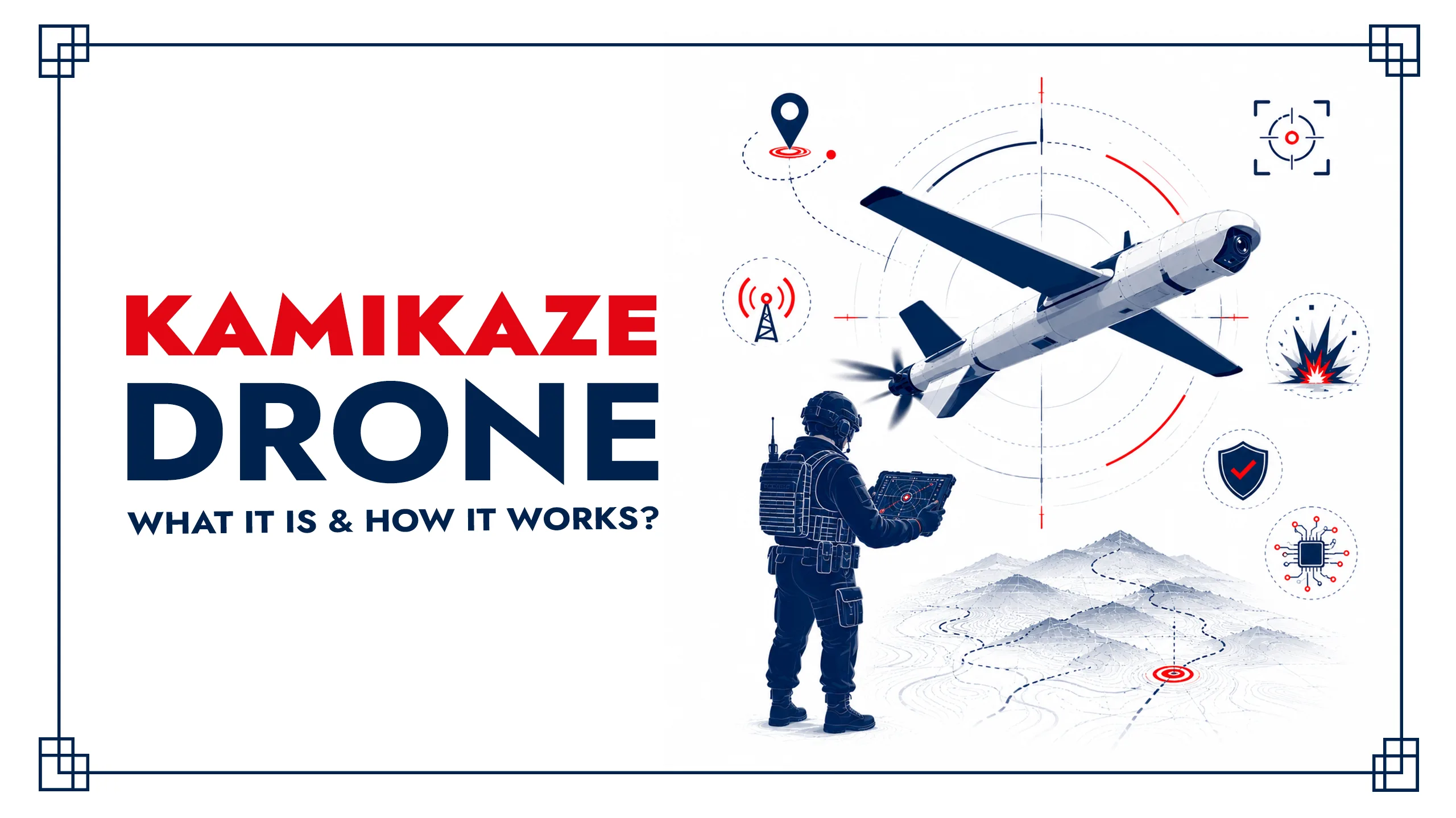
The battlefield has changed a lot in the past 20 years. Tanks, fighter jets and artillery still have their place, but a new class of weapon is reshaping how armies wage war around the world: the kamikaze drone.
Kamikaze drones are built to be the weapon, not like normal drones that go back home after their mission. It hunts a target, locates it and then charges into it with an explosive payload. Because of this special way of operating, these systems are also called loitering munitions.
Whether from the battlefields of Eastern Europe or the Middle East or Asia, kamikaze drones have demonstrated that relatively cheap unmanned systems can destroy millions of dollars of high-value military assets. India has also taken note and is investing heavily in both imported and indigenous loitering munitions to enhance its defence capabilities.
With warfare becoming increasingly technology-driven, knowing how these drones operate offers an important perspective on the future of military power.
What Is a Kamikaze Drone? (Definition & Meaning)
The kamikaze drone name is derived from the word “kamikaze”, a term used for Japanese pilots during World War II who crashed planes deliberately into enemy ships in suicide missions.
Modern military technology has adopted this idea, but in a very different form. The mission is flown by an unmanned aircraft either autonomously or by remote control . Instead of a human pilot sacrificing their life, a drone is used with explosives.
To put it simply, a kamikaze drone is a form of unmanned aerial vehicle (UAV) that carries explosives and is designed to destroy itself when it attacks a target. Unlike conventional missiles, it can linger in the air for a long time, waiting for a chance to strike.
That ability to hover above a battlefield is why these systems are often called loitering munitions. They have characteristics of both drones and guided missiles, and thus a hybrid weapon with flexibility and precision.
When people search for the kamikaze drone meaning, the simplest explanation is this: It is a single-use drone that finds a target and destroys it by crashing into it.
How Does a Kamikaze Drone Work?
A better way to understand how do a kamikaze drone work is in four stages.
1. Launch
The drone is launched from a vehicle, catapult, portable launcher or military platform. Some can even be launched from ships or larger aircraft.
Once in the air the drone will start to follow a pre-defined route or mission profile.
2. Loiter
It’s the difference between loitering munitions and conventional missiles.
The drone does not attack a target right away, but circles above an area waiting for a suitable target to present itself. This loitering period can range from minutes to several hours depending on the model.
It is like a hawk that is flying over a field. It doesn’t strike immediately, but it waits patiently until the time is right.
3. Target Identification
Modern kamikaze drones employ a combination of technologies to identify targets:
- GPS navigation
- Electro-optical cameras
- Infrared sensors
- Radar seekers
- Artificial intelligence-assisted recognition systems
- Data links connecting operators to the drone
Some advanced systems can also detect radar emissions, making them especially effective against enemy air-defense networks.
There is often still a human operator that has the final approval before the attack, but increasing automation is common.
4. Strike
When the target is identified, the drone proceeds to the attack phase.
The UAV flies towards the target at high speed, detonating its warhead on impact. The aircraft is part of the weapon itself, so it is not meant to return.
How Is It Different from Conventional Combat Drones?
A reusable combat drone like the MQ-9 Reaper carries missiles and returns to base when it’s done with its mission.
A kamikaze drone operates differently. The drone is the missile itself.
That makes it cheaper than many large combat UAVs, but it offers precision strike capability nonetheless.
Key Advantages of Kamikaze Drones
Loitering munitions are on the rise, and this is no accident. They have military advantages that are hard to match for conventional weapons.
Cost-Effectiveness
Affordability is one of the major attractions.
A missile battery could cost millions of dollars to operate, but some kamikaze drones can be built for a fraction of that. This lets militaries field large numbers without breaking the bank.
Precision Targeting
With modern guidance systems they can attack vehicles, artillery positions, command centers and radar systems with a high degree of accuracy.
Rather than destroy an entire area, commanders can target a specific threat.
Low Radar Signature
Many kamikaze drones are small and operate at relatively low altitudes.
Because of this they are hard to find with normal radar systems.
Psychological Impact
Perhaps the most overlooked is the psychological benefit.
Imagine listening to the constant hum of a drone above you for hours. Soldiers know it can hit at any time, but they don’t know exactly when or where.
In many respects, a kamikaze drone is like a silent hunter, hovering patiently above the battlefield. The uncertainty is a weapon itself.
Notable Kamikaze Drones from Around the World
Harop Kamikaze Drone (Israel)
One of the most respected loitering munitions in service today is the Israel Aerospace Industries Harop kamikaze drone.
What’s special about the Harop is that it can hunt enemy radars. It can detect radar emissions and automatically engage those sources, rather than depending solely on visual identification.
This capability is especially valuable in the early stages of a conflict when the destruction of enemy air-defense systems is critical.
The Harop has proven itself in a number of real conflicts and has built a reputation as one of the most sophisticated anti-radiation loitering munitions.
Harop is operated by a number of countries, including India. For Indian defence planners, the system offers a useful capability against heavily defended targets, while reducing risks to pilots and costly aircraft.
The Harop is the top end of the loitering munition range – less about numbers and more about accuracy, intelligence and strategic impact.
Iranian Kamikaze Drones (Shahed Series)
If the Harop is sophistication, the Shahed family is scale.
The most famous Iranian kamikaze drone is the Shahed-136.
Iran’s reply was very different from that of many Western states. Instead of concentrating on costly high-end systems, it developed drones that could be produced in large numbers at relatively low cost.
The method has garnered international attention in the Russia-Ukraine war, where Shahed drones have become a staple of long-range strike campaigns.
These drones are often described as disruptive by military analysts, because they upend traditional assumptions about air power. A relatively inexpensive drone can force defenders to launch expensive interceptor missiles, creating a large economic imbalance.
The Shahed series has demonstrated the potential of asymmetric warfare, in which cheaper systems can threaten far more expensive military hardware.
Their impact is not just on the battlefield. They’ve reconfigured conversations about drone manufacturing, supply chains and the economics of warfare to come.
Swadeshi Kamikaze Drones / Indian Kamikaze Drones
India’s push for loitering munitions comes from self-reliance.
Imported systems may give you capability immediately but the real long-term strategic strength comes from building it up at home.
One such example is the ALFA-S loitering munition being developed under DRDO led initiatives. These drones are designed to operate in swarms and provide Indian forces the ability to overwhelm defenses with coordinated attacks.
At the same time, private defense startups in India are developing AI-enabled UAVs with autonomous navigation, target recognition and complex communication systems.
Swadeshi kamikaze drones are important not only from a military capability perspective.
When you build indigenous systems you maintain control of technology, supply chains, upgrades and production capacity in times of crisis. It reduces dependence on foreign suppliers and helps India’s growing defence-industrial ecosystem.
Loitering munitions are a priority area in the larger Make in India programme as it is a good combination of state-of-the-art technology and good export potential.
For India, an effective Indian kamikaze drone is not just a way to keep up with global trends, but a strategic necessity to ensure strategic autonomy in an increasingly uncertain security environment.
India’s Broader Kamikaze Drone Strategy
India’s interest in loitering munitions is driven by pragmatic military realities.
It has a complex security environment, multiple borders and a need for rapid response precision strike capabilities that can be used without risking pilots.
The experience of world conflicts has provided its lessons.
Military planners observed the impact of loitering munitions on operations in Armenia-Azerbaijan, Ukraine and the Middle East. These battles proved that even small drones can take out armored vehicles, air-defense systems and command infrastructure.
Hence India has adopted a dual-track approach.
The first step is to meet the immediate operational needs with proven systems like the Harop.
The second track is around accelerating indigenous development through DRDO, defence public sector organisations and private industry.
The blend of acquisition and innovation mirrors the wider objectives of India’s defence modernisation.
Kamikaze Drone Costs: A Price Breakdown
When discussing kamikaze drone cost the answer is hugely variable depending on capability.
At the low end are short-range systems for tactical battlefield applications. These units can cost tens of thousands of dollars.
Mid-tier loitering munitions with advanced sensors, longer endurance and secure communication links can cost hundreds of thousands of dollars.
At the top of the line are sophisticated systems like the Harop, which combine advanced targeting technologies and specialized anti-radar capabilities.
Iranian drones have been a key element in global pricing discussions. The relatively low cost of production demonstrated that effective strike capability does not need to come from very costly platforms.
This has prompted many countries to consider mass-production models rather than relying on a few high-end weapons.
Countermeasures Against Kamikaze Drones
As kamikaze drones proliferate, armies are scrambling to build defenses.
Electronic warfare remains one of the best countermeasures. Jamming systems can interfere with communications and navigation signals and this can interfere with attacks.
Another promising solution is laser weapons. These systems might be able to target drones at the speed of light, and might be cheaper to operate than missile interceptors.
Interceptor drones are also emerging as a new layer of defence. The defenders do not fire from the ground, but employ drones that have been specially designed to hunt enemy drones.
The problem is economic.
Kamikaze drones can cost tens of thousands of dollars, but the missile that shoots it down could cost multiples of that.
One of the most important strategic issues facing modern militaries is this cost asymmetry.
Ethical and Legal Questions
The proliferation of loitering munitions raises hard ethical questions.
How much decision-making authority should be delegated to artificial intelligence?
Should a machine ever be allowed to choose and attack a target without direct human approval?
Supporters say that advanced sensors can reduce collateral damage by improving accuracy.
Critics fret over accountability. Assigning blame gets a good deal more complicated when an autonomous system errs.
International law is still catching up with these technological changes and discussions about autonomous weapons are likely to increase in the next years.
One of the defining defense-policy challenges of the drone era will be finding the right balance between military effectiveness and humanitarian concerns.
Conclusion
The kamikaze drone has evolved from an obscure military concept to one of the most consequential weapons of modern warfare. Loitering munitions give you the ability to surveil like a drone but the destructive power of a guided missile . This results in a whole new class of combat system .
Whether it is the sophisticated Harop kamikaze drone, the mass-produced Iranian kamikaze drones, or the emerging swadeshi kamikaze drones being developed in India, the message is clear that the future battlefield will see many more autonomous and semi-autonomous systems than in the past.
The challenge for India is not just to acquire these technologies but to master them indigenously. Smart procurement, indigenous innovation and effective counter-drone defenses will be the key to maintaining security in the decades to come.
FAQs
What does a kamikaze drone look like?
Most kamikaze drones look like small airplanes with fixed wings and a propeller in the back. They range from small backpackable systems to larger long-range drones that can fly hundreds of kilometers.
What is the Harop kamikaze drone?
The Harop is an Israeli-developed loitering munition that is designed to find and destroy high-value targets, particularly enemy radar systems. It is regarded as one of the most sophisticated anti-radiation kamikaze drones in use.
Which country uses Iranian kamikaze drones?
Iran has developed its own Shahed series of drones, variants of which have also been used by Russia in the Ukraine conflict.
What are swadeshi kamikaze drones?
Swadeshi kamikaze drones are loitering munitions, developed in India using indigenous technology, manufacturing and supply chains. They support India’s ambition for defence self-reliance.
How big is a kamikaze drone?
Sizes are very varied. Small tactical models could have wingspans of less than two meters, but larger long-range systems could be substantially bigger and carry heavier warheads.
Can kamikaze drones be stopped?
Yeah. The military is using radar systems, electronic jamming, interceptor drones, anti-aircraft weapons and new laser-defence technologies to find them and destroy them before they hit.

CEO, Mavdrones
Pradipta V Mukherjee is the visionary CEO of Mavdrones & Drone Pathshala, driving innovation and growth in the drone industry. With a passion for advanced technology, he leads the company's strategic direction, ensuring Mavdrones stays at the forefront of drone solutions. Under his leadership, Mavdrones has achieved remarkable success, including winning the 'Best Innovation and Technology in Drone Industry' award from ASSOCHAM. Pradipta is committed to revolutionizing the industry through advanced UAV technology, fostering a culture of excellence and forward-thinking within the organization.