The Role of RTK and PPK in Enhancing Survey Drone Accuracy


Table of Contents
In the evolving field of drone-based surveying, precision is not just a bonus— it’s the backbone of reliable geospatial data. RTK (Real-Time Kinematic) and PPK (Post-Processed Kinematic) systems are the most crucial technologies enabling this accuracy.
In this blog, we’ll explore how RTK and PPK technologies elevate the performance of survey drones, compare them in real-world applications, and highlight specific case studies where these GNSS correction systems have delivered unparalleled value.

🛰️ Understanding RTK & PPK in Survey Drones
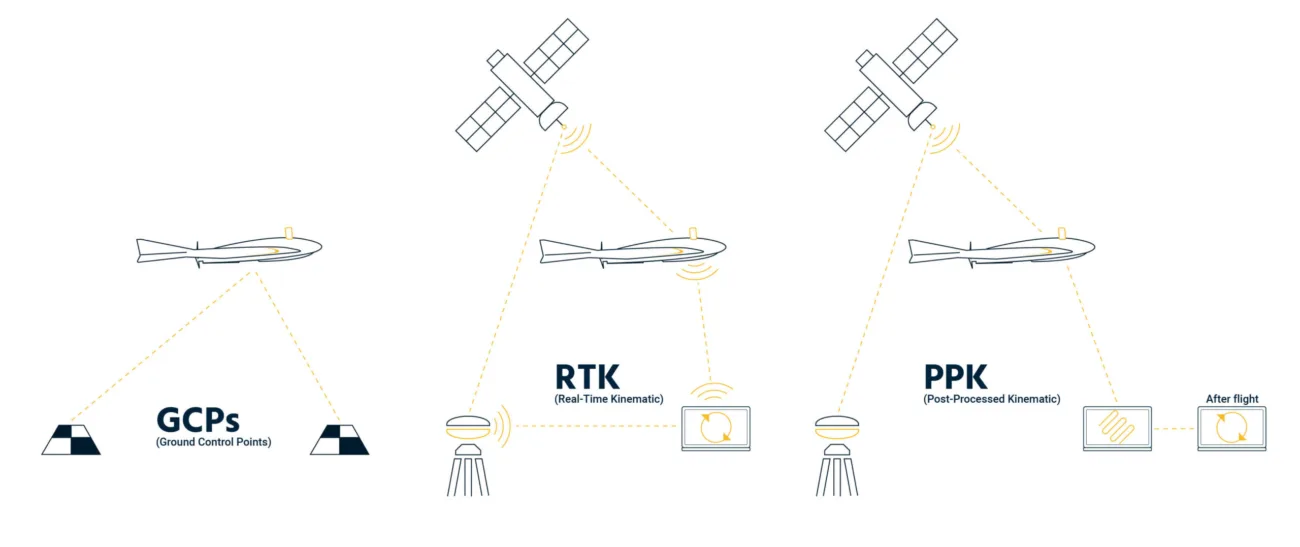
- RTK: A correction technology that delivers real-time data accuracy using a base station and a drone receiver. Ideal for on-site, immediate results.
- PPK: Post-processing of GNSS data after the flight, allowing for more flexibility and enhanced accuracy in environments with inconsistent connectivity.
Both systems correct the raw GPS signals that are often only accurate to 2-3 meters, narrowing them down to centimeter-level precision, which is crucial in cadastral, infrastructure, and volumetric surveys.
📊 RTK vs PPK: A Comparative Table
| Feature | RTK | PPK |
| Data Accuracy | Centimeter-level | Centimeter-level |
| Internet/Signal Dependency | Requires stable connection | Works offline |
| Use Case | Real-time mapping | Ideal for post-mission refinement |
| Processing Time | Instantaneous | Time-consuming (requires post-processing) |
| Flexibility | Less flexible on-site | High flexibility (especially in remote areas) |
🔧 Real-World Implementation Scenarios
📍1. Highway Alignment Survey– Maharashtra, India
Objective: Survey a 27 km stretch for highway expansion.
- Challenge: Uneven terrain, tree cover, and weak mobile signals.
- Solution: A PPK-enabled drone was deployed, allowing the team to collect GNSS data without relying on real-time corrections.
- Outcome: Post-processing yielded an RMS error of less than 3 cm, which was well within design tolerance. This data was integrated into the AutoCAD pipeline, saving 12 man-days of traditional surveying.
🏗️2. RTK for Real-Time Mapping in Urban Projects– Pune Smart City
Objective: Rapid mapping of urban infrastructure for smart planning.
- Approach: RTK-enabled drones like the DJI M300 RTK were used.
- Impact: Provided survey-grade output on the same day of flying, allowing instant decision-making for planners and civil contractors.
- Advantage: Reduced the project turnaround time by 35%.
🧪 Which One Should You Use? RTK or PPK
| Project Condition | Best Fit |
| Remote locations with poor network | PPK |
| Projects needing fast turnarounds | RTK |
| Missions with regulatory delays or flight restrictions | PPK |
| Surveys needing live georeferencing | RTK |
📐 How to Set Up RTK/PPK for Your Survey Drone
Key Equipment:
- Drone with RTK/PPK compatibility (e.g., DJI M300 RTK, WingtraOne, SenseFly eBee)
- Ground Control Points (optional for validation)
- GNSS base station or access to CORS (Continuously Operating Reference Station) network
- PPK software (like DJI Terra, Pix4Dmapper, or RedToolBox)
FAQs: RTK vs PPK in Survey Drones
1. What is the difference between RTK and PPK in survey drones?
RTK provides real-time GPS corrections during the flight, while PPK applies corrections after the flight during post-processing.
2. Which is more accurate—RTK or PPK?
Both offer centimeter-level accuracy, but PPK can be slightly more precise in complex environments due to its post-flight flexibility.
3. Do I need Ground Control Points (GCPs) when using RTK or PPK?
Not always—RTK and PPK can eliminate the need for GCPs, though a few checkpoints are recommended for validation.
4. Can RTK drones work without the internet?
RTK requires a stable connection to a base station or network (like NTRIP), so internet access or a radio link is typically needed.
5. Is PPK better for remote or rural surveying?
Yes, PPK is ideal for remote areas where real-time signal transmission may be unreliable.
6. Which drones support RTK and PPK technology?
Popular survey drone like the DJI Matrice 350 RTK supports both RTK and PPK workflow.
7. Does PPK take more time than RTK?
Yes, PPK requires extra post-flight processing time, but it offers more control and accuracy in difficult environments.
8. Can I convert RTK data to PPK?
Yes, flight logs from RTK drones can be used for PPK processing with compatible software.
🧭 Final Thoughts On Survey Drones
RTK and PPK technologies are redefining the standards of precision in drone-based surveying, enabling professionals to achieve high-accuracy results tailored to diverse project environments. While RTK supports real-time decision-making with instant corrections, PPK offers unmatched reliability in areas where connectivity is limited. The right choice depends on your project’s terrain, timeline, and data needs—but both are essential tools in the modern surveyor’s arsenal.
Looking to implement high-precision drone surveys with RTK/PPK capabilities? Partner with Mavdrones— India’s trusted expert in advanced drone surveying solutions. Let’s elevate your next project with data you can rely on.


CEO, Mavdrones
Pradipta V Mukherjee is the visionary CEO of Mavdrones & Drone Pathshala, driving innovation and growth in the drone industry. With a passion for advanced technology, he leads the company's strategic direction, ensuring Mavdrones stays at the forefront of drone solutions. Under his leadership, Mavdrones has achieved remarkable success, including winning the 'Best Innovation and Technology in Drone Industry' award from ASSOCHAM. Pradipta is committed to revolutionizing the industry through advanced UAV technology, fostering a culture of excellence and forward-thinking within the organization.