LiDAR vs Photogrammetry: Which Mapping Tech is Right for You?


LiDAR (Light Detection and Ranging) and photogrammetry are two technologies that have become industry leaders in the field of aerial mapping and surveying. Both have revolutionized how experts gather, examine, and interpret spatial data and are strong in their own right. However, if you’re thinking about spending money on drone-based mapping, you may be wondering: LiDAR vs photogrammetry: which is better suited for your use case?
To help you make an informed choice for your project or company, we’ll dissect each method’s advantages, disadvantages, and best-use scenarios in this post.
What Is LiDAR?
A remote sensing technique called LiDAR (Light Detection and Ranging) measures distances to the Earth using laser pulses. A LiDAR sensor mounted on a drone emits thousands of laser pulses per second and measures the time it takes for each one to return. Regardless of vegetation or lighting, this creates a very accurate 3D point cloud of the landscape and objects.

Key Benefits of LiDAR:
- Penetrates vegetation: Great for areas that are overgrown or forested.
- High accuracy: even in difficult terrain, centimeter-level precision
- Operates at night or in low light.
- Minimal distortion from post-processing
Limitations:
- Costly (software, drone compatibility, sensors)
- More specific knowledge is needed to operate and process data.
- Reduced image quality in contrast to photogrammetry
What Is Photogrammetry?
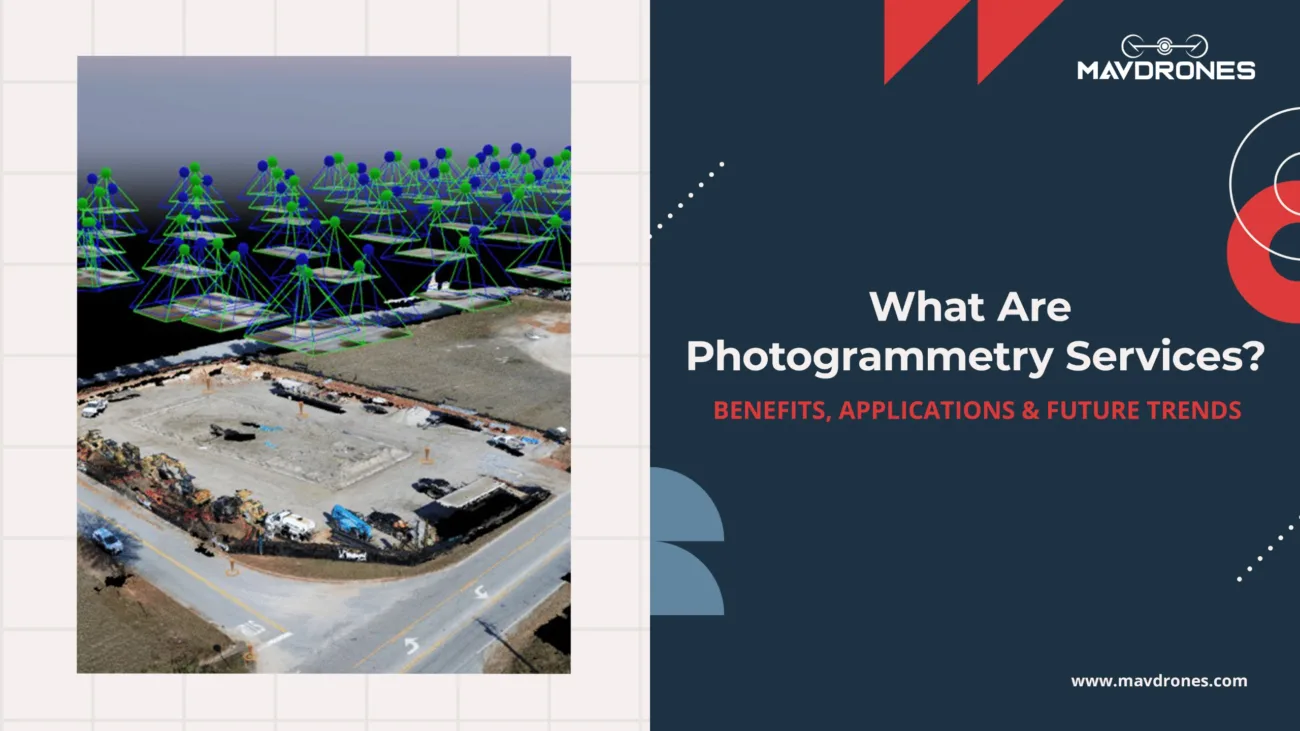
The science of measuring things from photos is called photogrammetry. High-resolution cameras on drones take overlapping pictures from various perspectives. Software is then used to process these photos in order to produce 2D maps or 3D models (such as orthomosaics, point clouds, DSMs, etc.).
Key Benefits of Photogrammetry:
- Cost-effective: Reasonably priced drones with cameras and software
- High-resolution images are helpful for planning and visual inspection.
- User-friendly: Simpler to implement and learn
- Excellent for construction sites or cities
Limitations:
- Battles in the forest canopy or thick vegetation
- Weather and lighting have an impact on accuracy.
- Requires regular flight planning and overlap.
- Not very effective at night
Comparing Accuracy: LiDAR vs Photogrammetry
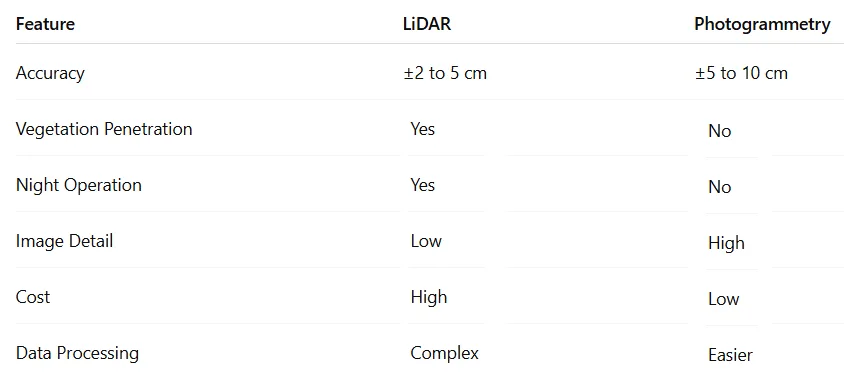
In the majority of cases, LiDAR is superior in terms of accuracy and precision. Even in the presence of trees or rough terrain, it offers incredibly detailed elevation data. In open, level spaces, photogrammetry is accurate; however, in situations where visual line-of-sight is blocked, it may not perform as well.
Use Cases: Where Each Tech Shines
When to Use LiDAR?
- Mapping Forestry and Vegetation: Maps the ground level by penetrating the canopy
- Corridor Mapping: Railroads, power lines, and pipelines are examples of corridor mapping.
- Mining and Volumetric Surveys: High-precision elevation models for mining and volumetric surveys
- Hydrology & Flood Risk Assessment: Accurate topographic information
When to Use Photogrammetry?
- Construction Monitoring: Visually clear progress tracking
- Urban Planning: Detailed visualizations and models of cities
- Real Estate & Land Marketing: 3D models and aerial photos for real estate and land marketing
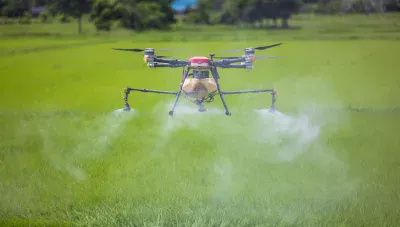
- Agriculture & Crop Health: NDVI mapping using multispectral imagery for agriculture and crop health
LiDAR and Photogrammetry in the Indian Context
LiDAR and photogrammetry are becoming more and more popular as India drives digital transformation in agriculture and infrastructure.
- LiDAR and photogrammetry are being used by the Digital India Land Records Modernization Programme (DILRMP) to digitize and update land records.
- Drone-based mapping is being used in India’s smart cities for infrastructure development, utilities, and planning.
- For high-resolution national mapping, the Survey of India has been combining the two technologies.
India’s varied terrain, which ranges from deserts in Rajasthan to forests in the Northeast, makes it crucial to select the appropriate technology for the situation.
Cost Consideration: What’s Right for Your Budget?
- Photogrammetry is your best option if you have a limited budget and your project doesn’t require critical accuracy or dense vegetation.
- LiDAR is worth the investment if your project requires high accuracy, terrain penetration, or you’re working in difficult conditions.
Additionally, LiDAR is now available as a service from a few drone service providers in India, eliminating the need for an initial hardware investment.
Conclusion: LiDAR or Photogrammetry — What Should You Choose?
The following factors determine whether to use LiDAR or photogrammetry:
- Your project’s objectives
- Spending limit (Budget)
- Terrain type
- Level of accuracy required
LiDAR is perfect for infrastructure audits, elevation mapping, and forests. Photogrammetry is frequently used in the fields of agriculture, construction, and real estate.
Professionals now combine the two technologies in many sophisticated operations, utilizing their distinct advantages to create more thorough models.
Frequently Asked Questions about Lidar vs Photogrammetry
Q1: Is it possible to combine photogrammetry and LiDAR in a single project?
Indeed, large-scale projects requiring elevation and visual data frequently use hybrid workflows.
Q2: Is it legal to use LiDAR for drones in India?
Yes, LiDAR operations are allowed under the right rules with drones and licenses that have been approved by the DGCA.
Q3: How much do LiDAR and photogrammetry drones cost?
While photogrammetry drones start at about ₹1.5–4 lakhs, LiDAR drones can cost up to ₹10–40 lakhs.

CEO, Mavdrones
Pradipta V Mukherjee is the visionary CEO of Mavdrones & Drone Pathshala, driving innovation and growth in the drone industry. With a passion for advanced technology, he leads the company's strategic direction, ensuring Mavdrones stays at the forefront of drone solutions. Under his leadership, Mavdrones has achieved remarkable success, including winning the 'Best Innovation and Technology in Drone Industry' award from ASSOCHAM. Pradipta is committed to revolutionizing the industry through advanced UAV technology, fostering a culture of excellence and forward-thinking within the organization.