Manual vs. Drone Spraying: See Who Wins on Indian Farms?


The use of drones for fertilizer and pesticide spraying is one of the most exciting developments in the constantly changing field of Indian agriculture. Indian farmers have historically used labor-intensive, time-consuming, and frequently dangerous manual spraying methods. However, the comparison between manual and drone spraying is becoming more relevant than ever as drone technology enters farmlands.
Let’s examine the main distinctions between these two approaches to see why drone spraying is not merely a fad but rather the farming of the future in India.
1. Time Efficiency
Manual Spraying: Depending on the crop, the terrain, and the weather, a farmer may cover one to two acres each day with a knapsack sprayer or other handheld equipment. For large farms or during urgent pest outbreaks, this renders it ineffective.
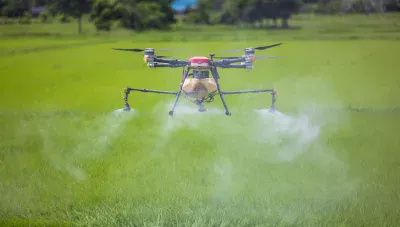
Drone Spraying: Depending on the model and payload, drones can spray 10–12 acres per hour. An agricultural drone with a 10-liter capacity, for instance, can finish spraying in a fraction of the time required by a team of workers working by hand. During time-sensitive phases like flowering or pest infestation, this is especially important.
👉 As a result, spraying with a drone can be up to ten times quicker than spraying by hand.

2. Labor and Safety
Manual Spraying: When spraying, employees come into direct contact with dangerous chemicals. Serious health problems like skin disorders, respiratory disorders, and even chronic illnesses can result from prolonged exposure.
Drone Spraying: Since drones are controlled remotely, no human interaction with chemicals is required when spraying. This lowers health hazards and lowers the price of protective equipment.
👉 As a result, workers and farmers are much safer when using drones for spraying.
3. Uniformity and Precision
Manual Spraying: Uneven coverage is frequently the result of manual spraying. It is common to apply too much or too little, which can damage crops or cause pesticide resistance.
Drone Spraying: To ensure uniform coverage and accurate droplet size control, drones utilize GPS and AI to fly along pre-programmed flight paths. To cut down on waste, some drones are outfitted with LiDAR or multispectral imaging to target only infected areas.
👉 Outcome: Drones provide more accurate and consistent input distribution.
4. Input Efficiency and Cost Savings
Manual Spraying: Up to 30–40% of urea or pesticides may be wasted as a result of overspray and runoff. This damages the soil and adjacent water bodies in addition to raising input costs.
Drone Spraying: According to field tests conducted by Indian agricultural universities, employing drones can save up to 20% to 30% on agrochemicals. According to some estimates, spraying also uses 90% less water.
👉 As a result, drone spraying uses fewer resources, saving chemicals and water.
5. Accessibility in Challenging Terrain
Manual Spraying: Manual spraying can be challenging and occasionally hazardous in hilly, marshy, or densely forested areas.
Drone Spraying: Drones can effortlessly traverse challenging terrain and variations in altitude. Drones have already proven to be very useful for spraying on steep slopes in states like Uttarakhand, Himachal Pradesh, and Northeast India.
👉 Outcome: Spraying is now possible in previously unreachable or dangerous locations thanks to drones.
6. Environmental Impact
Manual Spraying: Excessive runoff from excessive spraying can damage surrounding crops and wildlife, contaminate groundwater, and alter soil microbes.
Drone Spraying: Drone spraying reduces environmental pollution because of its focused approach. More sustainable farming methods are also facilitated by less chemical use.
👉 As a result, drones encourage environmentally friendly farming.
7. Government Support & Schemes
The Sub-Mission on Agricultural Mechanization (SMAM) of the Indian government has started a number of programs to encourage the use of drones after realizing their potential. Institutions can receive up to 100% financial assistance, and custom hiring centers (CHCs) can receive up to 50% subsidy.
In order to promote adoption, the Krishi Vigyan Kendras (KVKs) and ICAR institutions are also actively holding training sessions and field demonstrations.
8. Initial Cost and ROI
Manual Spraying: Although there is a small initial outlay, ongoing labor and chemical expenses mount up over time.
Drone Spraying: Depending on its features, an agricultural drone can cost anywhere between ₹3 and ₹10 lakh. To avoid ownership costs, farmers can also choose Custom Hiring Centers (CHCs) or drone service providers. Higher yields, lower labor costs, and lower input costs all contribute to a high return on investment (ROI) over time.
👉 Outcome: Although drones can be costly initially, they end up being cost-effective over time.
9. Yield and Crop Health
In India, field tests, such as those carried out by UAS-Bangalore and IARI-Delhi, show that using drones for spraying increases crop yields by 10–20%. Healthier crops and fewer losses from pests or nutrient deficiencies result from more precise application.
Conclusion: The Future is in the Sky
Indian farmers have long relied on manual spraying, but in the fast-paced world of agriculture today, its drawbacks are becoming more and more obvious. With its effectiveness, accuracy, and environmental friendliness, drone spraying has the potential to completely transform Indian agriculture.
We can anticipate that drones will become as ubiquitous in the field as tractors and tillers as government support grows and drone costs decline. The move to drone-based spraying is not only an improvement but also a wise long-term investment for Indian farmers, particularly those in charge of large or challenging-to-reach plots.
Are you interested in implementing drone technology as a farmer or agribusiness owner? For crop spraying drones or a free consultation, get in touch with us right now.

CEO, Mavdrones
Pradipta V Mukherjee is the visionary CEO of Mavdrones & Drone Pathshala, driving innovation and growth in the drone industry. With a passion for advanced technology, he leads the company's strategic direction, ensuring Mavdrones stays at the forefront of drone solutions. Under his leadership, Mavdrones has achieved remarkable success, including winning the 'Best Innovation and Technology in Drone Industry' award from ASSOCHAM. Pradipta is committed to revolutionizing the industry through advanced UAV technology, fostering a culture of excellence and forward-thinking within the organization.